
Public domains, exposed services, APIs, login portals, cloud accounts and forgotten subdomains can reveal more than a business expects. Black box security testing shows what an outside attacker may discover without access to internal diagrams or source code.
The phrase “black box security audit” can mean different things. This article focuses on a black box penetration test a technical assessment performed with little or no internal knowledge. A formal audit may also review policies, controls, records, governance and regulatory obligations. Providers such as ZealsTECH offer cybersecurity services for businesses but a penetration test alone doesn’t prove compliance or find every weakness. The process starts with permission and ends with evidence that teams can act on.
What Is Black Box Testing in Cybersecurity?
A black box security audit when used to mean penetration testing models an outsider’s view of a target. NIST defines penetration testing as an assessment in which testers attempt to bypass or defeat security features within defined constraints. OWASP also commonly approaches web application testing from a black-box perspective.
The starting information varies. Testers may receive only public company details and approved target addresses. In other cases they receive limited test accounts to examine authenticated areas without access to architecture documents, administrative credentials or source code.

Scoping, authorization and rules of engagement come first
Written authorization separates legitimate testing from an unauthorized attack. Before work begins the client and testing team agree on a rules-of-engagement document that defines where, when and how testing will occur.
That document should cover:
- Approved domains, IP addresses, applications, APIs, cloud assets, test accounts, testing dates and allowed windows.
- Rate limits, prohibited actions, excluded systems, emergency contacts, data handling, service agreements and escalation procedures.
These limits reduce the risk of downtime, account lockouts, false alerts, customer disruption or accidental data changes. A professional team uses controlled exploitation and pauses when a test could harm production systems. ZealsTECH can set expectations through transparent planning for penetration testing engagements.
Production testing needs clear stop conditions. A valid finding is not worth a customer outage or corrupted business data.
Reconnaissance, attack-surface mapping and manual testing
Testers then collect publicly available intelligence. They identify subdomains, exposed ports, server technologies, login flows, API endpoints public storage locations and third-party services connected to the target.
Automated scanners help locate common issues but they don’t establish whether a weakness is real or exploitable. Manual testing confirms the finding and traces its likely impact. For example testers may validate broken access control, weak authentication, injection flaws, exposed secrets, insecure configurations, vulnerable components or business logic errors.
A controlled proof of concept may show limited access to sensitive data or a restricted privilege change. The goal is to demonstrate risk without taking unnecessary actions. Black box security testing provides useful attacker-focused evidence yet it cannot promise complete coverage of every hidden system or vulnerability.
What Black Box Security Testing Can and Cannot Prove
A black-box assessment answers a focused question: what could a skilled external attacker reach and exploit within the approved scope and time? It does not assess every internal control, employee process, network segment or source-code path.
Black box web application penetration testing is also different from a vulnerability scan. A scanner casts a wide net quickly and may report false positives. Penetration testers validate findings, test exploitability and explain practical business impact.
Black box, grey box, white box and compliance audits serve different goals
The right approach depends on the system, risk, available time and decision that the organization needs to make.
| Assessment type | Information provided | Primary purpose |
| Black box | Little beyond public information | External attacker view |
| Grey box | Limited accounts or documentation | Deeper workflow and access testing |
| White box | Source code, architecture, configurations | Broad technical review |
| Vulnerability scan | Target inventory and scanner access | Fast issue discovery |
| Compliance audit | Policies, evidence and control records | Review of required obligations |
Grey-box testing can examine authenticated workflows that an outsider cannot reach. White-box work supports source-code review and deeper architecture analysis. A compliance audit reviews governance and evidence so a successful penetration test does not establish regulatory compliance. Teams comparing vendors can review common penetration testing questions before committing to a scope.
How to Use Findings and Choose the Right Service
Black box security testing is a strong fit before a product launch an enterprise customer review a major application change a cyber insurance renewal or the release of systems handling sensitive data. It gives leaders an independent view of public exposure.
Grey-box or white-box testing may be a better choice for internal systems, complex authorization paths, source-code review or deep cloud architecture analysis. Organizations evaluating penetration testing services should match the engagement type to the decision they need to support. ZealsTECH should also explain its methodology, scope boundaries, communications plan and retesting process before testing starts.
A useful report turns evidence into clear next steps
A professional report includes an executive summary, scope, limitations, testing dates, methods, risk ratings, affected assets, proof of concept, business impact, reproduction steps, remediation guidance and retest results. Generic scanner output is not enough.
Findings should rank both exploitability and likely harm. Ask whether the provider protects test data, communicates during active testing, explains uncertainty and helps teams validate fixes.
Final Perspective
A black box security audit usually means an external perspective but the exact scope must be confirmed. A formal compliance audit and a black box penetration test answer different questions.
Strong engagements authorize the work, define boundaries, map the attack surface, validate weaknesses manually, assess impact, report clearly and retest fixes. Choose black box, grey box, white box, scanning or compliance work based on the organization’s goal. ZealsTECH can be one provider to evaluate when that decision requires experienced technical testing.
Frequently Asked Questions
What Is Black Box Penetration Testing?
Black box penetration testing is an authorized security assessment where testers examine a system with little or no knowledge of its internal structure. They approach the target like an external attacker and identify exposed assets security weaknesses and possible attack paths without access to source code architecture documents or privileged credentials.
How Is Black Box Penetration Testing Performed?
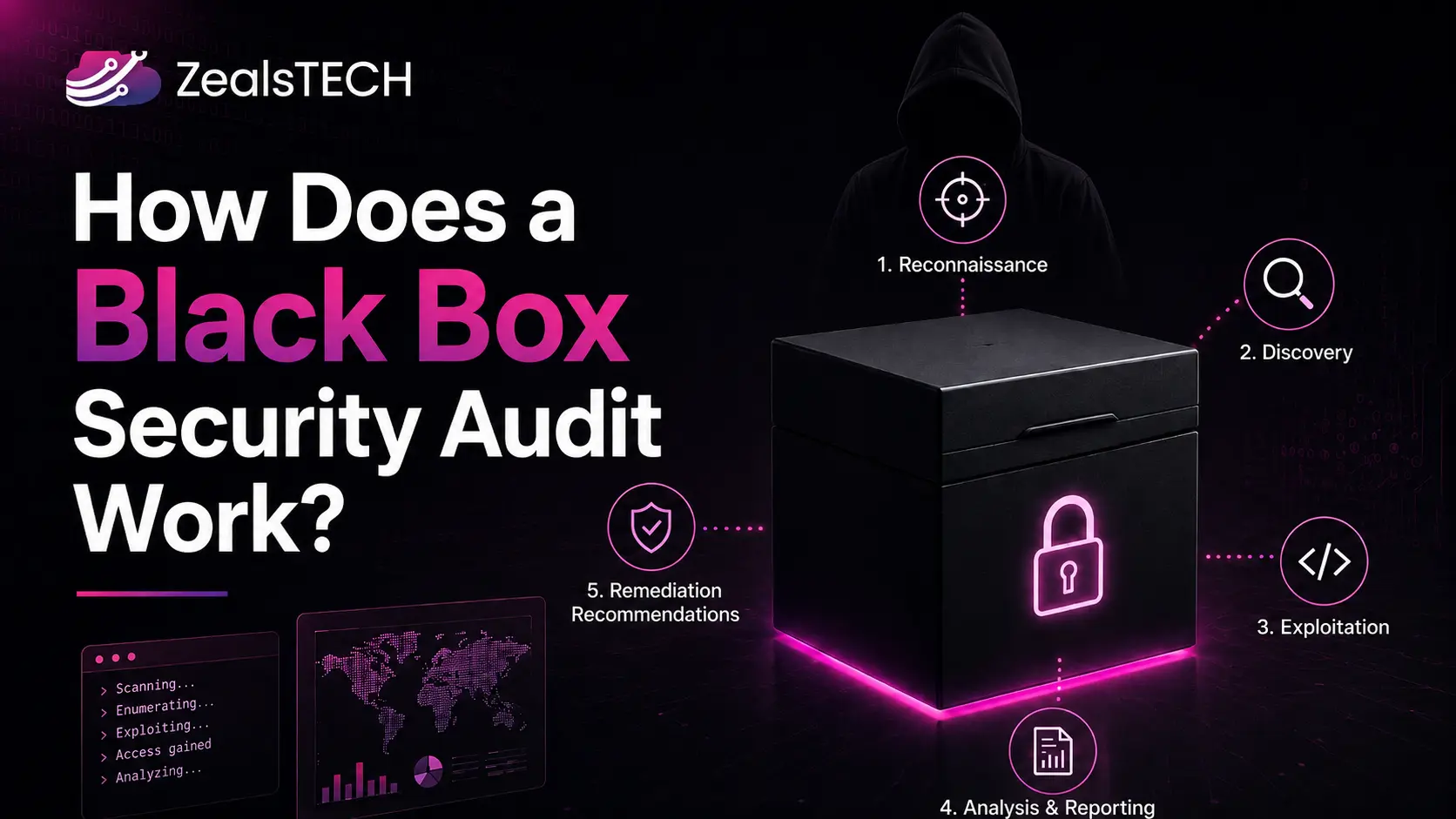
Black box penetration testing begins with defining the scope and rules of engagement. Testers then conduct reconnaissance map the external attack surface identify vulnerabilities and manually validate potential weaknesses. Controlled exploitation may be performed to confirm business impact. The engagement ends with a detailed report remediation guidance and optional retesting.
What Is the Difference Between White Box and Black Box Penetration Testing?
Black box penetration testing gives testers minimal information and focuses on what an external attacker can discover. White box penetration testing provides full access to source code credentials architecture and technical documentation. Black box testing offers greater attack realism while white box testing usually provides deeper and more comprehensive security coverage.
When Performing Black Box Penetration Testing What Information Does the Tester Have?
During black box penetration testing the tester usually has limited information about the target. They may receive domain names application URLs public IP addresses testing dates and scope restrictions. They normally do not receive source code internal network diagrams system credentials or detailed architecture documentation unless specifically agreed.
Which Statement Correctly Describes Black Box Penetration Testing?
Black box penetration testing is best described as an authorized security test performed from an external attacker’s perspective with minimal prior knowledge of the target. The tester discovers public-facing systems identifies weaknesses validates exploitable vulnerabilities and evaluates potential business impact while following an agreed scope and rules of engagement.
What Are the Characteristics of Black Box Penetration Testing?
Black box penetration testing is characterized by limited internal knowledge external attack simulation reconnaissance attack-surface discovery manual vulnerability validation and controlled exploitation. It focuses on publicly accessible systems and realistic attack paths. However it may provide less coverage of internal code configurations user roles and hidden functionality than grey-box or white-box testing.