
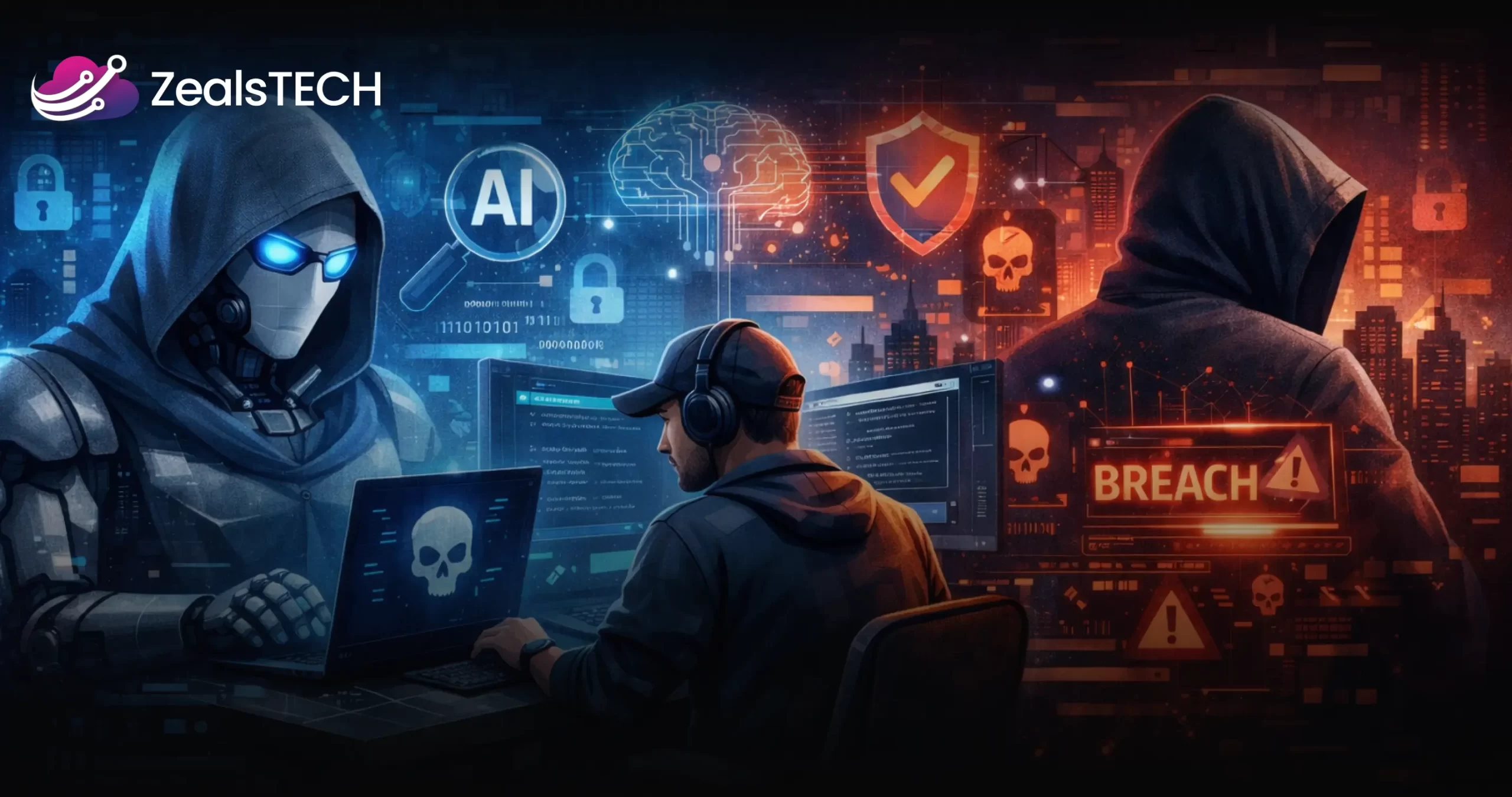

Manual pen tests can feel like checking every window in a skyscraper, one floor at a time. It takes time, budgets are tight, and release cycles keep speeding up. At the same time, real attackers already use AI to scale recon, write better lures, and hunt for weak points faster than most teams can patch.
That’s why AI-assisted pen testing is getting serious attention in 2026. It can help teams move quicker and cover more ground, but it also adds new failure modes that security leaders can’t ignore.
This article breaks it down into roles (where AI helps), risks (where it can fail or create exposure), and reality (how to adopt it safely), with a practical view of what modern penetration testing services should look like.
What AI-Powered Pen Testing Really Means in 2026
When vendors say “AI pen testing,” most aren’t talking about a robot hacker that runs a full engagement end-to-end. In practice, AI-powered pen testing usually means AI-assisted workflows wrapped around classic security methods: scanners, manual validation, known exploit patterns, and well-tested rule sets.
Think of AI as a sharp assistant who reads fast, takes notes, and spots repeats. It can:
- automate parts of recon and enumeration,
- find patterns across noisy results,
- prioritize what a human should test next,
- speed up report drafting and retesting.
But there’s a second side to this story. AI is also in the hands of attackers. It helps them scale social engineering, write malware faster, improve exploit research, and run wider recon with less effort. The result is simple: defenders need speed and coverage, but they also need control and proof.
Many security teams start by pairing AI with established programs like managed cybersecurity services so AI outputs get reviewed, tracked, and governed, not treated as a magic answer.
Where AI helps most today: recon, triage, and faster retesting
AI shines when the work is repetitive and time-boxed. For example, it can map an external attack surface by pulling together domains, subdomains, exposed services, and certificate clues, then summarize what changed since last month.
During testing, AI can group scanner findings into clusters (same root cause, same affected endpoints), summarize logs, and highlight “odd” API behavior that deserves manual checks. After fixes, it can speed up validation by re-running targeted tests and comparing results, which fits DevOps teams shipping weekly.
It doesn’t replace expertise, but it reduces the wait time between “we shipped a fix” and “we know it worked.”
Where humans still win: creative attacks, business context, and proof
Humans still outperform AI when the job requires judgment. A good tester can chain small issues into a real breach, like combining a weak password reset flow with an authorization mistake to reach sensitive data.
People also catch what tools miss: hidden trust boundaries, fragile business rules, and the difference between “a bug exists” and “this is how money or data leaves the building.” They can also write findings that engineering teams can act on, and that compliance teams can defend during audits.
In short, buyers don’t pay for tool output. They pay for impact, evidence, and clarity.
The New Roles AI Plays Across Penetration Testing Services
AI is changing the day-to-day shape of a pen test. The biggest shift is not flashy exploitation, it’s coverage. With skill shortages across many regions (especially outside the USA), teams are using AI to widen what gets reviewed in a fixed time window.
A modern engagement often looks like this: AI accelerates discovery and analysis, then a human tester selects the highest-risk paths, validates exploitability, and documents business impact. That model also helps control costs, because senior experts spend less time sorting noise and more time proving real risk.
Providers that run structured engagements, like ZealsTECH’s ethical penetration testing services, typically combine automation with manual testing and reporting, so results are usable by both technical and non-technical stakeholders.
Web app and API testing: finding patterns, then verifying impact
Web apps and APIs are perfect targets for AI assistance because they produce lots of “signals”: requests, responses, tokens, roles, parameters, and error messages. AI can mine traffic to discover endpoints, map auth flows, and spot parameter patterns that look injection-prone or misconfigured.
In web app pentesting, AI can also help identify “near-duplicate” issues across pages and services, which reduces repeated manual effort. For APIs, it can flag anomalies like unexpected status codes, inconsistent schema behavior, or endpoints that behave like they’re missing authorization checks.
Still, the high-risk work needs a person. Broken access control is rarely a single payload. It’s logic, role design, and data flow. Human testers verify whether an endpoint truly leaks data, whether an account takeover is possible, and what an attacker could do next. That’s why teams still rely on dedicated application penetration testing to confirm impact across web, mobile, and API surfaces.
Network and infrastructure testing: faster discovery, careful exploitation
On networks, AI can speed up asset discovery and service fingerprinting, then help prioritize likely weak paths. It can summarize exposures like old VPN endpoints, risky remote access, misconfigurations, or identity weaknesses that often show up in Active Directory environments.
Where teams need caution is exploitation and lateral movement. A “helpful” automated action can also break things, trigger account lockouts, or cross a boundary that was out of scope. That’s why AI-assisted network work still needs strict controls, defined rules of engagement, and careful operator judgment, especially during internal testing.
For many organizations, the safest approach is to use AI to organize and prioritize, then keep exploitation tightly managed through expert-led network penetration testing with clear evidence collection and safe stopping points.
Risks, Limits, and the Reality Check Leaders Need
For CISOs, CTOs, and compliance leads, the question isn’t “Should we use AI?” It’s “Where do we use it, and what guardrails do we require?” The best program is AI-augmented, with clear approvals, strong logging, and strict data handling.
AI can reduce time-to-find and time-to-validate, but it can also introduce new exposure if teams treat it like an autopilot. Regulators and auditors won’t accept “the model said so” as proof. Neither will your incident response team after a breach.
A practical reality check: the more powerful the tool, the more it needs governance. That includes who can run it, what data it can see, and how actions are recorded. If you’re buying penetration testing services that include AI workflows, ask how the provider prevents mistakes, protects your data, and verifies results.
What can go wrong: false confidence, data leaks, and unsafe autonomy
AI risks tend to fall into a few buckets:
- False positives and false negatives: AI can misread noisy signals, miss subtle auth flaws, or overstate a finding that doesn’t hold up in practice.
- Hallucinated explanations: A model may sound confident while guessing root cause or remediation steps.
- Model drift and prompt issues: Changes in tools, inputs, or prompts can shift results over time.
- Mishandled secrets: Tokens, passwords, and API keys can get pulled into logs, prompts, or shared workspaces.
- Third-party data exposure: Sending customer data to external AI services can create privacy and compliance problems.
- Out-of-scope actions: Automated steps can exceed rules of engagement unless approvals and logging are enforced.
Using AI doesn’t reduce the need for written authorization, scope control, and traceable records. It increases it.
A practical adoption plan: start small, measure results, keep humans in control
Start with one narrow use case and prove value before expanding:
- Pick one workflow (triage or retesting works well).
- Set success metrics (time to validate fixes, reduction in noise, fewer missed criticals).
- Require human sign-off before any exploitation or privilege escalation.
- Document data flow (what goes into tools, where it’s stored, who can access it).
- Run manual spot checks each cycle to confirm accuracy and catch blind spots.
Conclusion
AI is pushing pen testing forward by improving speed, coverage, and retesting cadence. Humans still matter because they prove real risk, connect technical flaws to business impact, and keep findings credible for engineers and auditors. Guardrails make the difference between helpful automation and new exposure.
If you’re deciding what to do next, evaluate AI-augmented testing against your environment, your threat model, and your compliance needs. The goal isn’t to chase hype, it’s to get clearer answers faster, without losing control.
Frequently Asked Questions
What are managed cybersecurity services, and how do they differ from antivirus software?
They offer expert 24/7 monitoring and response, surpassing antivirus’s reactive scans.
Is switching to a managed cybersecurity services provider cost-effective for SMEs?
Yes, with 35-50% savings through bundled, outcome-based pricing.
How quickly can a managed cyber security services provider detect and respond to threats?
Under 30 minutes, powered by AI and dedicated SOC.
What industries benefit most from IT cyber security services?
E-commerce, finance, manufacturing, and tech services.
How does ZealsTECH ensure compliance in cybersecurity services?
Via automated audits and adherence to GDPR, ISO, and regional regs.
Can I integrate managed cybersecurity services with my existing IT setup?
Yes, with flexible APIs and minimal downtime.