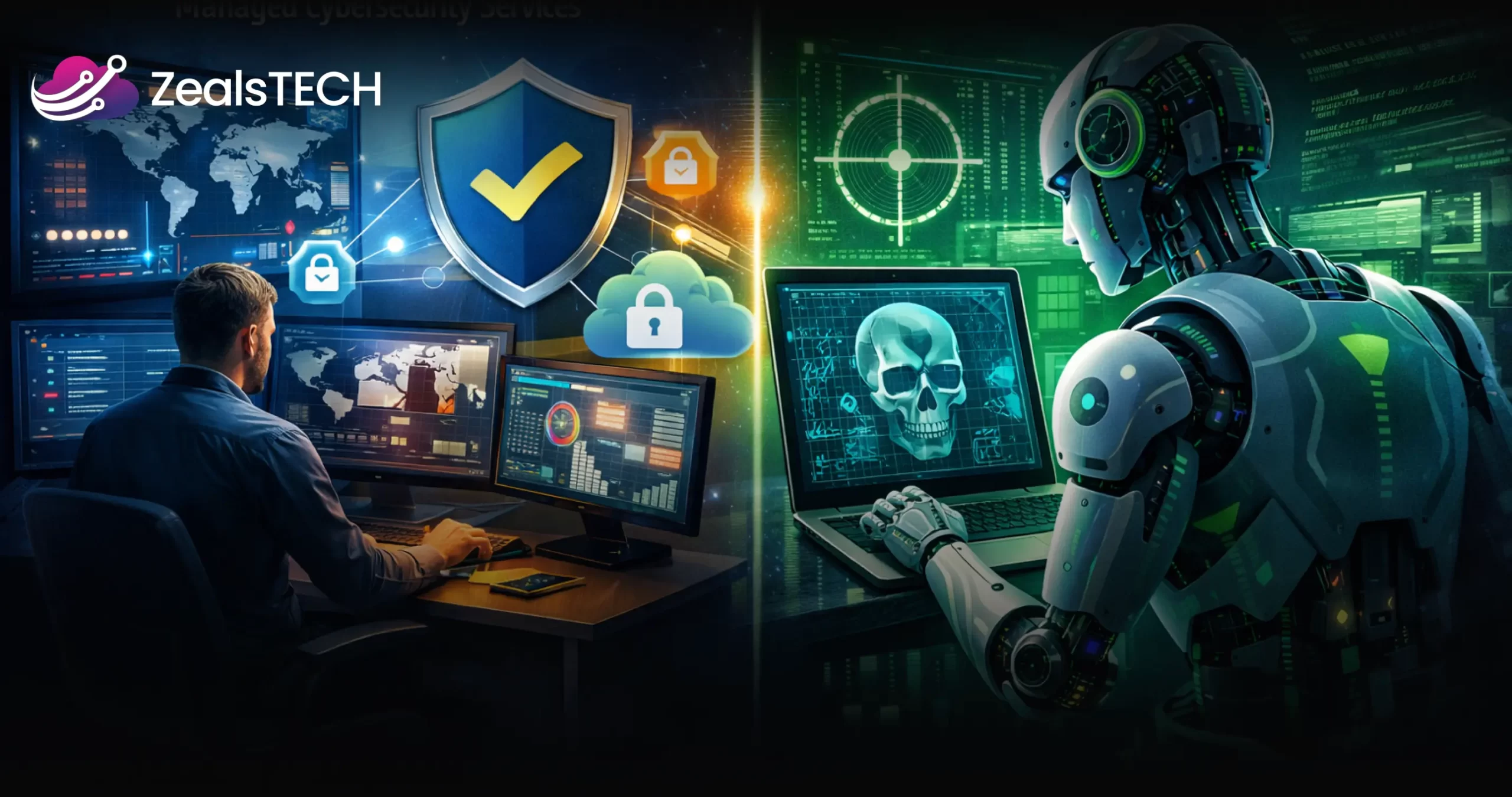
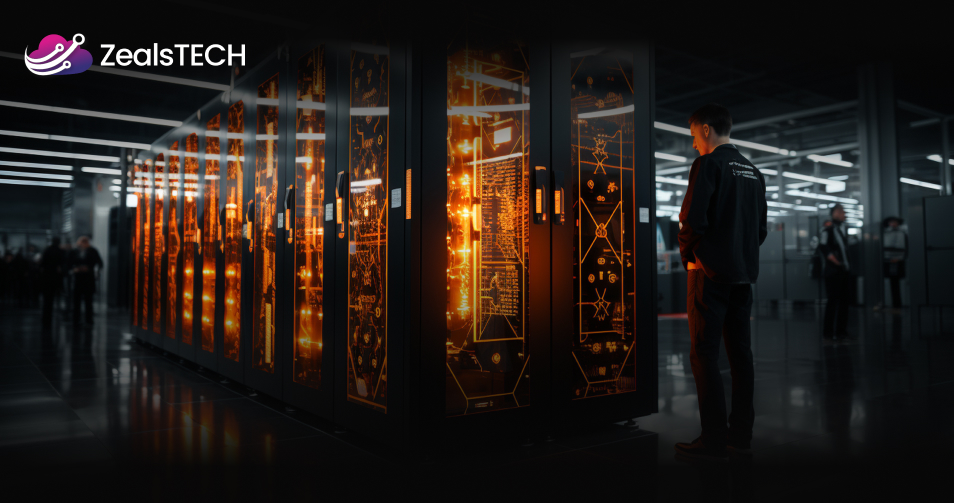

The digital economy is expanding at such an exhilarating pace that it has completely surpassed traditional IT infrastructure in the past few years. Companies now need to manage vast amounts of data and tackle complex tasks by relying on automation to maintain their competitive edge. With artificial intelligence spearheading these advancements, there’s a rising demand for enhanced speed, scalability, and reliability. In response, innovative new data centers are emerging to meet these exciting challenges.
AI data centers are changing how businesses approach computing, storage, networking, and efficiency. These centers are more than just improved server rooms. They are smart environments built to handle advanced analytics, machine learning, and automation on a large scale.
As companies use AI in their operations, customer service, security, and decision-making, their IT infrastructure needs to keep up. This leads to a key question:
What Is An AI Data Center?
At its essence, it refers to a purpose-built data center for artificial intelligence. These are designed for computing, optimization, data pipelines, and automation. An AI data center works by empowering organizations to innovate confidently while maintaining stability and security.
In this blog, we’ll look at how AI-powered data centers are changing IT infrastructure, why they’re important for businesses and service providers, and how they’re shaping the future of digital technology.
The Evolution of Data Centers
For decades, data centers followed a predictable model. Physical servers were installed, manually configured, and maintained by in-house teams. In the past, capacity planning used to rely on forecasts rather than real-time data. Performance issues were addressed after disruptions occurred. While this approach supported early enterprise computing, it struggles under modern demands.
With the growth of cloud computing, distributed apps, and real-time analytics, the limits of old infrastructure became clear. Companies started searching for ways to automate setup, boost uptime, and better understand how their systems perform. This change set the stage for smart, AI-powered data centers.
AI in modern data centers is a big leap forward. Rather than needing people to make every change, AI systems constantly review thousands of data points. This lets them automatically decide how to place workloads, use energy, manage cooling, and spot problems. The result is a system that adjusts on its own as conditions change.
Another major milestone in this evolution is the convergence of cloud and AI technologies. Hybrid and multi-cloud environments now depend on centralized intelligence to maintain performance and security. Cloud-based data center security ensures that AI-driven workloads remain protected even as they scale across distributed environments.
As businesses modernize, data centers are becoming active partners. They now help keep operations running, improve efficiency, and drive new ideas.
AI Data Center Infrastructure and Its Core Components
To understand AI data center infrastructure, you need to look past just the hardware. These environments bring together special computing tools, fast connections, smart management systems, and strong security.
High-Performance Computing and Acceleration
AI workloads are computationally intensive. Training machine learning models and running inference engines requires a higher level of processing power that standard CPUs alone cannot provide. AI data centers rely heavily on supercomputers, like high-output GPUs, TPUs, and other accelerators, optimized for parallel processing.
These components enable faster data analysis and real-time decision-making. They also influence facility design, since power density and heat output are significantly higher than in conventional environments. Advanced power distribution and thermal management systems are essential to maintain stability and efficiency.
Data Infrastructure for AI at Scale
AI systems tend to depend on large volumes of high-quality data. This makes data infrastructure for AI a defining element of modern data centers. High-throughput storage, low-latency networking, and intelligent data pipelines ensure that information flows smoothly between systems.
Scalability plays a critical role here.
When AI models evolve, and datasets grow, infrastructure must expand alongside them without disruption. Software-defined storage and networking solutions allow resources to be allocated dynamically, which supports growth while controlling costs.
This data-centric approach also improves visibility. AI-powered analytics provide real-time insights into performance, utilization, and bottlenecks, enabling teams to make informed decisions quickly.
AI in Data Center Operations
Operational intelligence happens to be the most impactful benefit of AI adoption. AI in data center operations transforms how facilities are managed by shifting oversight from reactive to predictive.
Machine learning models can analyze historical and real-time data to anticipate hardware failures, identify abnormal behavior, and recommend corrective actions before issues escalate. This proactive approach reduces overall downtime and improves service reliability for companies looking to streamline their operations.
Tasks such as workload balancing, patch management, and capacity planning are handled with minimal manual input. This allows professional IT teams to focus on strategic initiatives rather than routine maintenance.
Security and Interconnected Systems
As data centers become more intelligent and interconnected, security must evolve in parallel. AI-enabled environments require strong defenses to protect data, workloads, and infrastructure components.
Network and infrastructure fortification with the help of AI tools can help monitor traffic patterns, detect anomalies, and respond to potential threats in real time. Integrated security frameworks can help maintain trust within the clientele across complex environments that span on-premises systems and cloud platforms.
Benefits and Business Impact of AI-Driven Data Centers
The shift toward AI-powered infrastructure delivers measurable value across technical and business dimensions. These benefits address many of the challenges organizations face when scaling digital operations.
Operational Efficiency and Cost Optimization
Energy and water consumption are by far the largest operational expenses in data centers. AI-driven optimization plays a major role in reducing this burden. Intelligent systems can adjust cooling, power distribution, and workload placement on their own based on real-time conditions, without any monitoring.
This continuous optimization lowers energy usage without sacrificing performance. Over time, these efficiencies translate into significant cost savings and improved sustainability metrics.
Improved Reliability and Uptime
Downtime tends to have far-reaching consequences that can negatively impact revenue and customer trust. AI for data center operations can enhance reliability by predicting failures before they occur.
By identifying early warning signs such as temperature fluctuations, power anomalies, or performance degradation, AI systems enable timely intervention. Such a predictive maintenance model reduces unexpected outages and significantly extends the equipment lifespan.
Enhanced Security Posture
Cybersecurity is the top concern for companies that wish to adopt AI and automation. Intelligent data centers strengthen defenses through continuous monitoring and adaptive threat response.
AI systems have the potential to learn normal behavior patterns across networks and applications. So when deviations occur, automated responses can isolate only the affected systems and alert security teams immediately to intervene. This approach supports advanced protection strategies aligned with comprehensive cybersecurity solutions in enterprise environments.
Scalability and Business Agility
Modern businesses tend to thrive when their infrastructure evolves with the demands of the market. AI-driven data centers empower this evolution with rapid, effortless scaling and automatically adjusting resources based on workload. Such adaptability enables organizations to confidently introduce new services and meet seasonal peaks.
Improved Decision-Making and Visibility
AI-powered analytics provide deep visibility into infrastructure performance and usage patterns. Leaders gain actionable insights that inform capacity planning, investment decisions, and risk management.
This data-driven approach strengthens governance and aligns IT operations with broader business objectives.
The Role of Data Centers in Artificial Intelligence Adoption
As AI is integrated into the workflows of various industries, the significance of robust infrastructure cannot be overstated. Data centers for artificial intelligence are the backbone of innovation. They enable exciting applications like predictive analytics, intelligent automation, and real-time personalization. Organizations that harness AI need environments that promote continuous learning and agile development. AI data centers offer the vital computational and operational support for training models, rolling out updates, and swiftly analyzing results. This is especially valuable in sectors such as healthcare, finance, manufacturing, and logistics.
Sustainability and the Environmental Impact of AI Data Centers
Sustainability has become essential for enterprises, and there’s exciting progress underway. The pressure on businesses to reduce environmental impact while boosting performance is higher than ever. Here is a pros and cons table of AI data centers in relation to sustainability:
| Pros | Cons |
| Energy efficiency advancements encourage better server design, smarter power usage, and more efficient cooling systems. | High energy demand from AI workloads increases pressure on electrical grids. |
| Increased use of renewable energy as major data center operators invest in solar, wind, and clean power sources. | Greenhouse gas emissions remain a concern when data centers rely on fossil fuel–based electricity. |
| Innovative cooling technologies and AI-driven airflow optimization reduce energy waste. | Heavy water consumption for cooling can strain local water supplies, especially in drought-prone areas. |
| Potential for long-term emissions reduction as AI helps optimize energy systems, transportation, and industrial processes. | Resource-intensive hardware manufacturing requires rare earth metals and critical minerals. |
| Higher computing efficiency per square foot allows more processing power in smaller physical spaces. | Growing electronic waste results from frequent hardware upgrades and shorter equipment lifespans. |
| Stronger corporate sustainability commitments promote transparency through environmental reporting and net-zero goals. | Localized environmental impact occurs when large data centers are concentrated in specific regions. |
| Opportunities for waste heat reuse enable excess heat to support nearby buildings or district heating systems. | Land use concerns arise from large-scale data center construction and infrastructure expansion. |
The Future of Intelligent IT Infrastructure
The future of IT infrastructure is intelligent, autonomous, and deeply integrated with business strategy. AI data centers will continue to evolve, incorporating more advanced automation, self-healing capabilities, and real-time optimization.
Emerging trends tend to point toward fully autonomous facilities that require minimal human oversight. In the coming years, edge computing will likely extend AI capabilities closer to users, improving performance for latency-sensitive applications.
As this future takes shape, organizations will need the expert guidance of an IT expert to navigate complexity and align technology investments with long-term goals. This is where trusted partners become invaluable.
ZealsTECH supports organizations through AI-driven IT infrastructure consulting, helping enterprises design, deploy, and manage intelligent data center environments that meet global standards while addressing real-world business needs.
Conclusion
AI data centers are revolutionizing the management of IT infrastructure for businesses. Such innovative systems provide predictive insights and automated control. They empower organizations to remain resilient and adapt seamlessly to changing market demands. Embracing these transformations can truly upgrade the regular operational capabilities of any business to new heights.
By deploying AI data center infrastructure purpose-built for modern workloads and guided by intelligent operations, organizations can unlock greater performance, lower costs, and more secure outcomes.
With the evolution and further development of Artificial Intelligence, the ecosystems that support it are also evolving. The future of data centers is both powerful and promising. For companies ready to embrace this change and stay competitive, partnering with an expert like ZealsTECH can aid you in navigating this transition with confidence.
Frequently Asked Questions
What is an AI data center, and how does it differ from traditional data centers?
An AI data center is different as it has been specifically designed to handle AI workloads with high computational demand and advanced networking. Unlike traditional centers, it incorporates specialized hardware like GPUs, machine learning-driven control systems, and intelligent cooling and power optimization.
How does AI improve performance and security in data center operations?
AI allows for continuous environmental conditions and user activity monitoring, along with workload distribution. This enables predictive adjustments to resource allocation, early detection of anomalies, and automated threat response, boosting both performance and protection.
What are the key components of any AI data center infrastructure?
Core elements include high-performance accelerators, fast networking fabrics, intelligent control software, and scalable storage systems. These components work together to support intensive compute tasks and deliver real-time analytics.
Can AI-driven data centers reduce operational costs for large enterprises?
Yes. By automating routine tasks, improving energy efficiency, and enabling predictive maintenance, AI systems cut down on both energy and labour expenses, making operations more cost-effective over time.
How do smart data center solutions contribute to sustainability and energy efficiency?
AI tools analyze the usage patterns and environmental data to optimize power and cooling systems. This results in an overall energy use and carbon footprint reduction. Digital simulations such as digital twins can further enhance planning and efficiency.
What is the future outlook for AI and data infrastructure integration?
The predictive data points toward a future with increasingly autonomous centers and tighter integration with edge computing. There will be real-time optimization and self-healing systems that respond instantly to issues. AI will continue to shape infrastructure planning across industries.